Expert Strategies for Superior Swimming Pool Cleaning and Water Chemistry
A superior swimming pool is the result of a deliberate, well-executed strategy that goes beyond simple skimming and chlorination. It’s an art form that balances physical cleanliness with the complex science of water chemistry. Achieving and maintaining a truly pristine aquatic environment requires a deeper understanding of how all the components of your pool system work together. This comprehensive guide will reveal the expert strategies that pool professionals use to ensure every pool they service is a model of clarity, safety, and health. We will delve into advanced techniques for both Swimming pool cleaning, and flawless water chemistry management, providing you with the knowledge to elevate your own pool care routine to the highest level.
Elevating Your Physical Cleaning Routine: The Pro’s Approach
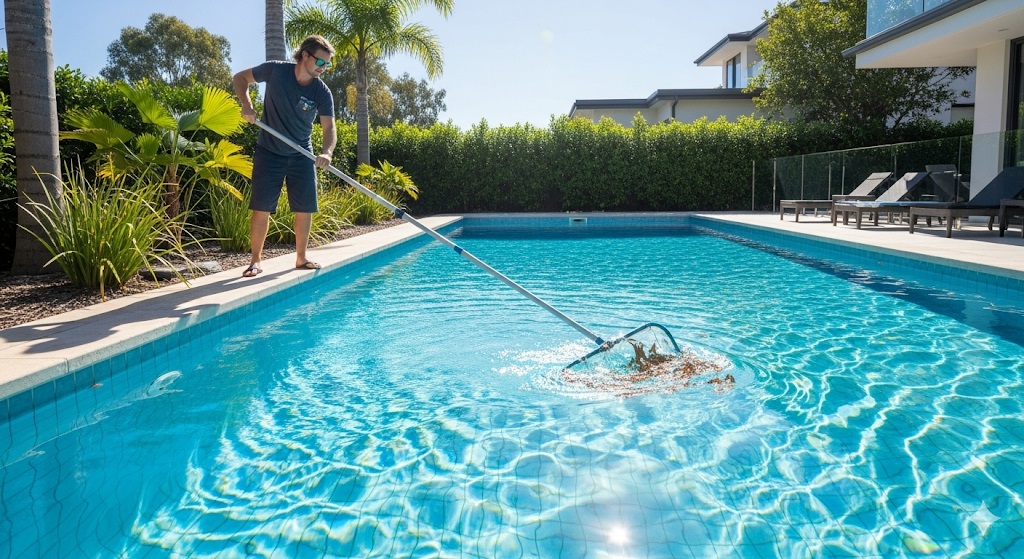
While the basics of skimming, brushing, and vacuuming are essential, experts know how to perform these tasks with maximum efficiency and effectiveness. It’s about working smarter, not harder.
Mastering the Brush-and-Vortex Technique
Brushing is not just about scrubbing; it’s about dislodging particles so your filtration system can capture them. Expert pool technicians use a specific technique: they brush the walls and floor, starting from the shallow end and working towards the deep end. This directs all the loosened debris toward the main drain, where it can be sucked up and sent to the filter. For pools with multiple main drains or no main drain, brushing towards the skimmers is the next best option. This targeted approach ensures that no debris is left behind, reducing the workload on your filter and keeping your water clearer.
Strategic Vacuuming: When to “Vacuum to Waste”
For pools with a sand or DE filter, the “vacuum to waste” function is a powerful tool for serious swimming pool cleaning. When your pool has a significant amount of dirt, silt, or dead algae on the bottom, vacuuming it through the filter can clog it instantly and send the debris right back into the pool. By setting the filter valve to “waste,” you bypass the filter entirely and pump the dirty water directly out of the pool and onto your lawn or into a sewer line. While this process does lose a certain amount of water, it is by far the fastest and most effective way to remove heavy contamination, saving you hours of frustrating filter cleaning and potential equipment damage. This technique is a cornerstone of professional pool restoration.
The Power of an Automated Cleaner: A Smart Investment
While manual cleaning is effective, it is time-consuming. Robotic pool cleaners have become an indispensable tool for experts. They are completely independent of your pool’s main circulation system, featuring their own pump and filter. This means they are not only incredibly efficient at picking up debris but they also take the strain off your main filter. The best robotic cleaners can map out the pool, climb walls, and scrub the waterline, ensuring a meticulous clean. They are a one-time investment that saves countless hours of manual labor and keeps your pool consistently clean, providing a level of cleanliness that is difficult to achieve otherwise.
The Science of Water Chemistry: A Deep Dive into Balance
This is where the true expertise comes in. While you can eyeball a dirty pool, you cannot eyeball chemical imbalances. A proactive and precise approach to water chemistry is the single most important factor in maintaining a superior swimming pool.
Beyond the Basics: Understanding the Langelier Saturation Index (LSI)
Most pool owners focus on the “Big Five”: pH, Free Chlorine, Total Alkalinity, Calcium Hardness, and Cyanuric Acid. Experts go a step further by calculating the Langelier Saturation Index (LSI). The LSI is a formula that determines whether your pool water is corrosive, balanced, or scale-forming. A perfectly balanced pool has an LSI of 0.0.
- Negative LSI (-0.3 or lower): The water is corrosive. It will aggressively seek minerals from your plaster, grout, and metal equipment, leading to surface etching and equipment corrosion.
- Positive LSI (+0.3 or higher): The water is scale-forming. It will deposit calcium and other minerals on your pool surfaces, especially on tile lines and in your filter, making your pool’s surface feel rough and reducing filtration efficiency.By using a comprehensive test kit that measures all the necessary parameters, you can calculate the LSI and make targeted adjustments to keep your pool in perfect balance, preventing long-term damage and costly repairs.
Cyanuric Acid (CYA): The Double-Edged Sword
Cyanuric Acid, or CYA, is a stabilizer that protects chlorine from being destroyed by the sun’s UV rays. Without it, your chlorine would be gone in a matter of hours. However, too much CYA can be a serious problem. High levels of CYA (above 50 ppm) can “lock up” your chlorine, making it far less effective at sanitizing the water. This is why you might have a high chlorine reading but still have an algae problem. The chlorine is present, but it’s not active enough to kill contaminants. The only way to lower high CYA levels is to partially drain the pool and add fresh, unstabilized water. Managing CYA is a crucial part of expert water chemistry.
The Role of Phosphates and Their Impact on Pool Health
Phosphates are an organic compound that acts as a primary food source for algae. They can enter your pool from a variety of sources, including fertilizers, decaying organic matter, and even some common pool chemicals. Even with a perfect chlorine level, a high phosphate count can lead to a persistent algae problem. Experts regularly test for phosphates and use a specialized phosphate remover to keep levels in check. By starving the algae of their food source, you make it far easier for your sanitizer to do its job and keep your pool crystal clear.
Specialized Treatments for Common Pool Problems
Beyond daily maintenance, experts have a toolbox of solutions for specific problems that can plague a pool.
Flocculants vs. Clarifiers: Choosing the Right Solution for Cloudy Water
When your pool is cloudy due to fine particles that are too small for your filter to catch, you have two options.
- Pool Clarifier: This liquid solution works by causing the tiny particles to clump together, forming larger particles that your filter can then trap. It’s a slow and steady process and requires you to run your filter for an extended period.
- Pool Flocculant (Floc): This is a much more aggressive treatment. It causes all the suspended particles to clump together and sink to the bottom of the pool in a thick layer. Once the particles have settled, you must manually vacuum the debris to waste, bypassing the filter entirely. Flocculants are a fast solution for a major cloudiness problem but require a significant amount of manual labor.
The Power of Enzymes for Oily Water
If your pool water feels greasy or has a scum line at the waterline, it’s likely due to a buildup of non-living organic contaminants like suntan lotion, body oils, and cosmetics. These can also overwhelm your sanitizer. Expert technicians often use pool enzymes to break down these compounds, making it easier for your sanitizer to work and keeping your water feeling and looking pristine. Adding a small amount of an enzyme product to your weekly maintenance routine can make a huge difference in the overall water quality and clarity.
The Professional Touch: When to Call for Reinforcements
Despite all the knowledge and effort, some situations require professional intervention.
- Persistent Algae: If you’ve shocked your pool multiple times and the algae keeps coming back, there’s likely a deeper problem, such as extremely high CYA or phosphates, or an underlying issue with your circulation system. A professional can diagnose the problem and provide a targeted solution.
- Major Equipment Failure: A failing pump motor, a cracked filter tank, or a malfunctioning heater are complex repairs that should be handled by a certified technician.
- Leak Detection: If your pool is losing water at a rapid rate, a professional with specialized leak detection equipment can pinpoint the exact location of the leak without the need for destructive investigation.
A truly superior swimming pool is the result of continuous, informed care. By adopting these expert strategies for both your physical swimming pool cleaning and your water chemistry management, you will not only solve existing problems but also prevent future ones from ever occurring. This proactive approach saves you time, money, and frustration, leaving you with a perfectly clean and healthy pool that is always ready for you to enjoy.